Kannada Article by: Soumya Pradeep
English Rendering by: Padmini Shrinivasan
Respond to (lekhana@ayvm.in)
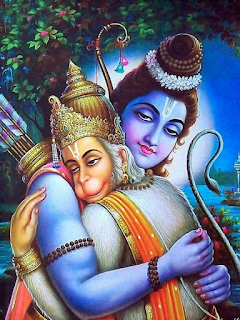
Aanjaneya, a great devotee, executed Sriraamachandra's errands with utmost veneration, regarding Him as the prime source of his sustenance; he thus earned the goodwill of Sriraamachandra and Seethamaata. Searching for the whereabouts of Seetha, he performed a herculean feat of crossing the ocean to reach Lanka; met Seetha under the ashoka tree; consoled her and passed on the message of his master to her; returned with Seetha's message and became instrumental in uniting the two. Similarly, during the war between Raama and Raavana, when Lakshmana fell unconscious the valorous Aanjaneya flew to the Himalayas to fetch Sanjeevini herb, along with the hill! This way Aanjaneya executed many formidable tasks for his Lord with a happy countenance.
One of the poets while portraying Sri Raama has skillfully described the repercussions of our actions (karma). Though deeply impressed with Hanumaan, Sri Raama told him "You have performed very mighty tasks for my sake. Yet, do not expect anything in return from me, because the one, who desires return favours, invites calamities in reality". If we help a person, who is in distress and expect a return, then, are we not justified in getting back our services only when we are in trouble?! The gist here is that Sri Raama wished that no misery or associated difficulties should befall Hanumaan. An additional message to all is that, when a return favour is expected the doer gets bound by the action (karma-bandhana). The fruits reaped out of every one of our actions, is preordained. Some day, commensurate with our activities, the meritorious deeds fetch us auspicious fruits while bad deeds fetch us equally bad fruits. Again, some results of actions are obtained immediately, whereas some others may take a long time. Yet a few other fruits have to be reaped over several births! The impact of karmas is intricate. So, rejecting bad deeds on all accounts, we should continue to perform our actions bereft of the 'I, Mine' feelings; then the action becomes a karmayoga when it is performed without expecting any return and with a feeling of submission to the Lord. Then, without binding us, it leads us through a path to unify us with the Supreme Lord. As the Lord himself says – "All we need to do is to perform our ordained duties zestfully - karmanyevaadhikaaraste maa phaleshu kadaachana". (Your authority lies in the performance of actions alone and never on the fruit of actions).
Aanjaneya never expected anything in return but executed the jobs with zest and devotion to the Lord, through body, mind and speech. Immortality and Sri Raama's embrace were the best fruits he attained. In contrast, Raavana who worked against the righteous path set by the Lord became a target for Sri Raama's arrows, culminating in his death.
As per Srirangamahaaguru's words - "In our lifetime, whatever actions we execute must have a significance. It should guide us to our roots. Our daily activities must be such that they show us the way to the Lord". Let us all engage ourselves in pursuits adored by the Lord and become karmayogis.
